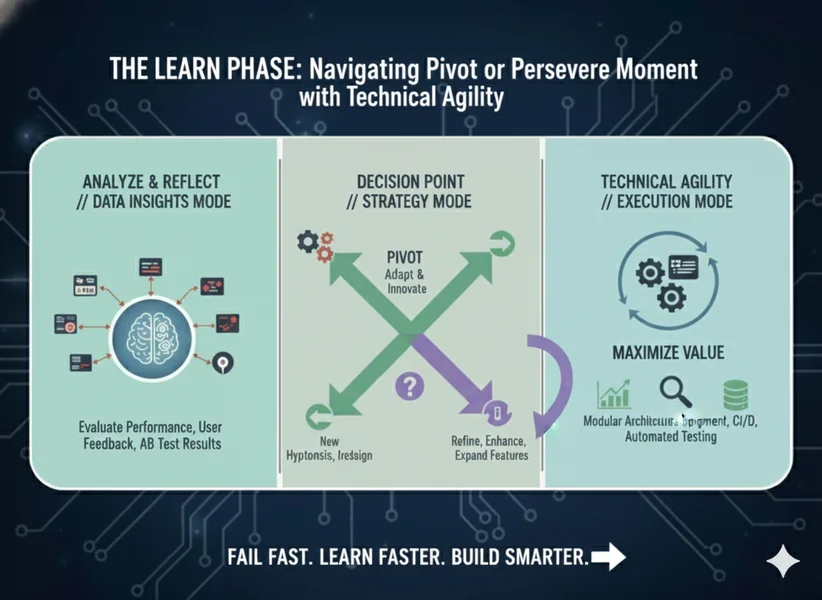
In the high-velocity world of solopreneurship, the period immediately following a product launch is often referred to as the "Post-Launch Hangover." You have successfully "vibe coded" your minimum viable product (MVP) and implemented a rigorous system of innovation accounting. Now, you find yourself at the most critical junction of the Build-Measure-Learn loop: the decision to pivot or persevere.
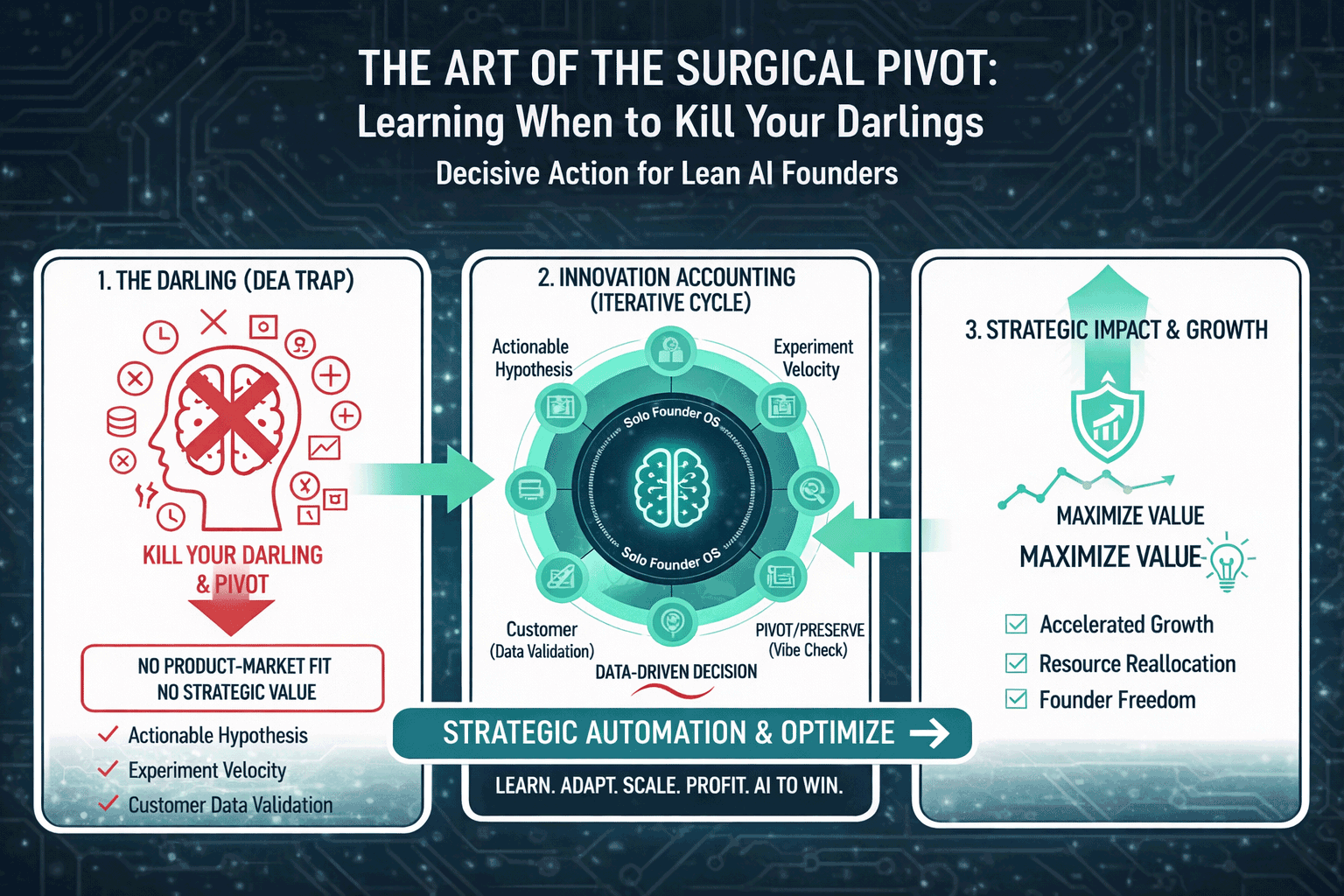
For many founders, this moment is fraught with emotion. It is the point where personal intuition meets hard market data. In the LeanPivot framework, this is not a moment for guesswork, but for a calculated, strategic choice. A pivot is defined as a fundamental change in business strategy to test a new hypothesis about the product, business model, or engine of growth. It is not a failure, but a course correction designed to find a path toward a sustainable business.
The Psychology and Mechanics of the Pivot
The concept of the pivot is central to the Lean Startup methodology. It recognizes that even the most brilliant founders rarely get the product-market fit exactly right on the first attempt. The goal of the "Learn" phase is to minimize the total time through the loop, allowing you to iterate until you find a signal worth scaling.
The goal of the "Learn" phase is to minimize the total time through the loop, allowing you to iterate until you find a signal worth scaling.
Common Pivot Strategies for Solopreneurs
Solopreneurs are uniquely positioned to pivot quickly because they lack the bureaucratic inertia of larger teams. Several pivot types are particularly effective in the early stages:
- The Zoom-In Pivot: This occurs when a single feature of your MVP becomes the entire product. For example, a founder building a complex project management tool might discover that users are only using the "automated file renaming" feature. In a Zoom-In pivot, that feature becomes the new standalone product.
- The Customer Need Pivot: Sometimes, you discover that the problem you aimed to solve isn't the one users are most frustrated by. While your target segment remains the same, you shift the product to solve a more intense, "hair-on-fire" problem you discovered during interviews.
- The Value Capture Pivot: This involves changing your revenue model. You might pivot from a flat subscription to a usage-based "credits" model, or move from a B2C individual focus to a B2B "per-seat" model to capture more value from enterprise users.
- The Channel Pivot: Your product may be great, but you are reaching users through the wrong medium. A shift from organic SEO to a high-touch direct sales model—or moving from a web app to a mobile-first experience—can fundamentally change the growth trajectory.
The Go/No-Go Framework
To decide between pivoting or persevering, the framework utilizes an objective "Go/No-Go" scorecard. This prevents founders from being misled by vanity metrics or paralyzed by the fear of making a mistake. The scorecard relies on three primary data sources:
Using Better Stack as a Decision Engine
Better Stack serves as the "truth source" for technical feasibility. By unifying uptime monitoring, logs, and incident management into a single platform, it allows a solopreneur to distinguish between a failed product hypothesis and a failed technical execution.
- The Technical "No-Go": If your logs show frequent errors and your uptime is dipping, your poor engagement metrics might simply be due to a broken app. In this case, you "persevere" with the product idea but "pivot" your focus to technical stability.
- The Product "No-Go": If Better Stack shows 99.9% uptime and zero critical errors, but your PostHog funnels show massive drop-offs at the activation step, you have a clear signal that the product itself—not the technology—is failing to resonate. This is the moment to consider a strategic pivot.
Better Stack’s ability to pivot from a slow trace directly to the exact logs generated during that request is vital. It provides the full context needed for debugging, showing you the exact log messages generated during a user's frustration. This level of clarity ensures that your "Learn" phase is based on facts, not feelings.
Executing the Pivot with GitOps and Argo CD
Once the decision to pivot is made, the solopreneur must execute with extreme speed. Every day spent lingering on a failed hypothesis is "wasted" runway. To facilitate this, the framework introduces GitOps through Argo CD.
The Power of Declarative Infrastructure
Argo CD is a Kubernetes-native continuous delivery tool that ensures the live state of your cluster matches the desired state defined in your Git repository. For a solo founder, this provides several "superpowers":
- Automated Reconciliation: If you update your application code to reflect a new pivot, Argo CD automatically pulls the change and deploys it. You no longer need to manage complex, manual deployment pipelines.
- Safety and Rollbacks: If a high-speed pivot results in a "degraded" state, Argo CD allows for near-instant rollbacks. By simply reverting the change in Git, the cluster is automatically synced back to the last known healthy state.
- Predictability: Because your entire infrastructure is "versioned and immutable" in Git, you have a full record of every change made during your pivot experiments.
By using the "pull-based" model of Argo CD, solopreneurs create a more secure and resilient environment. It decouples the build process from the deployment process, allowing you to iterate on features without risking the stability of the entire system.
Database Mastery with Neon
A common "Pivot Killer" is the accumulation of technical debt, particularly within the database. Migrating schemas and managing production data during a pivot can be terrifying for a solo founder. Neon solves this through database branching.
Branching Data Like Code
Neon allows you to "branch your data the same way you branch your code." This enables a "branch-per-pull-request" workflow that is essential for rapid iteration:
This approach eliminates the setup time required to deploy and maintain a development database. It turns the database from a fragile bottleneck into a flexible asset that supports the pivot rather than hindering it.
The Science of "Software for One"
The ultimate realization of the Learn phase is that software development has shifted toward Andrej Karpathy's concept of "Software for One." This describes highly personalized, AI-generated tools designed to address specific, immediate needs.
In the Learn phase, the solopreneur acts as the orchestrator of these needs. By using AI agents to build "vertical slices" of the pivoted product, the founder can test multiple directions in a single week. The loop is no longer a months-long process but a daily habit.
Implementation Strategy: The $100 Revenue Test
The final capstone of the Learn phase is the $100 revenue test. The goal is not to build a massive user base, but to prove that the current "vibe" of the product is valuable enough for someone to pay for.
Using tools like Autumn to manage flexible pricing tiers, a founder can quickly test if a pivot toward a premium feature or a usage-based model is viable. Autumn sits between your app and Stripe, allowing you to update pricing models in a UI without redeploying code. This is the ultimate tool for "Value Capture" pivots, letting you experiment with "credits," "seats," or "tiers" until you find the model that converts.
Conclusion: The Loop as a Permanent Operating Model
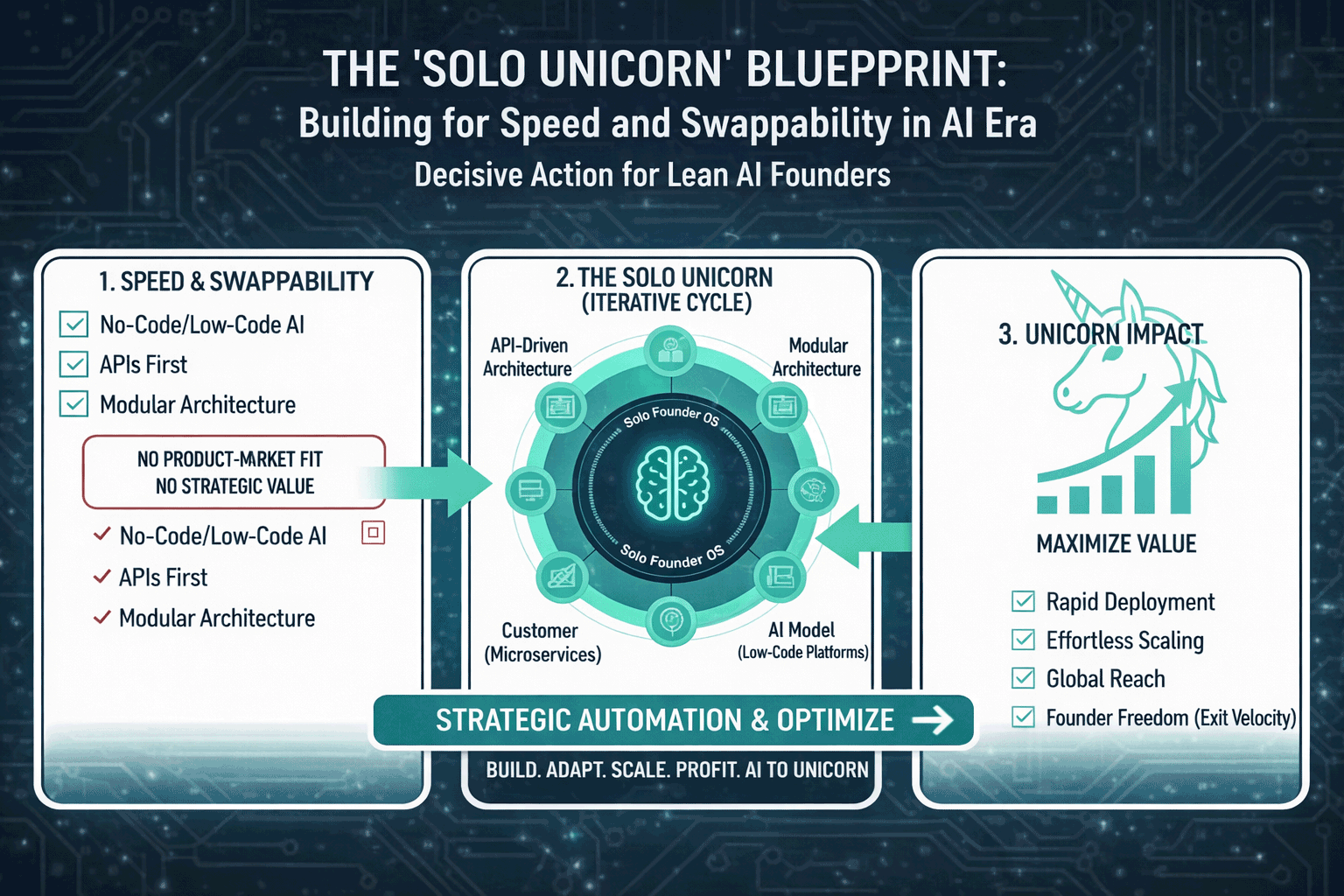
The Learn phase is not a one-time event; it is the permanent operating model of the "Solo Unicorn." By mastering the tools of the "Scale Stack"—Better Stack for observability, Argo CD for GitOps, and Neon for data integrity—the solopreneur builds a business that is "antifragile." It doesn't just survive change; it thrives on it.
The solopreneur builds a business that is "antifragile." It doesn't just survive change; it thrives on it.
The Build-Measure-Learn loop, supported by the speed of vibe coding and the evidence of innovation accounting, transforms the uncertainty of a startup into a repeatable science. Whether you decide to persevere with your vision or pivot toward a newly discovered opportunity, you do so with the confidence that your technology can keep pace with your ambition. In the 2026 development landscape, the founders who win are not those who never fail, but those who learn the fastest.

No comments yet
Be the first to share your thoughts on this article!