We have a romanticized, and frankly dangerous, view of how great businesses start.
We imagine the "Eureka!" moment—the lone founder sitting in a darkened room or a bustling coffee shop when a lightning bolt of genius strikes, revealing a billion-dollar idea out of thin air. We celebrate the "pivot" and the "instinct," but we rarely talk about the labor that precedes them. In reality, relying on "inspiration" is the fastest way to stay stuck. Inspiration is fickle, it is unscalable, and most dangerously, it usually leads you toward the same "obvious" ideas that everyone else is having at exact same time.
If you’ve spent any time in AI circles lately, you’ve seen the "obvious" ideas cluttering Product Hunt:
- "ChatGPT for Lawyers."
- "AI-powered Email Writer."
- "The Generic PDF Summarizer."
These aren't businesses; they are features that have been slightly repackaged. Because they lack Structured Creativity, they fail to find the hidden gaps in the market—the "Dark Matter" we discussed in Post 2. They are destined to be "Sherlocked" by the big model providers because they are built on the surface level of human imagination.
The Myth of the Blank Page: Why Constraints are Your Friend
The biggest enemy of the solopreneur is the blank page. When you ask your brain to simply "think of a business idea," it freezes. This is the Paradox of Choice. When the field is infinite, the cognitive load required to narrow it down becomes paralyzing.
Structured creativity works by applying deliberate constraints. By narrowing the field of vision and forcing your brain to look through a specific "lens," we trigger lateral connections that the logical mind would otherwise ignore. We don't want to build "something for someone." We want to use specific mental models to twist, break, and rebuild existing services until something unique, defensible, and high-value emerges.
Here are the three primary engines we use to move from "Generic AI" to a "High-Value AI Venture."
The SCAMPER Framework for AI
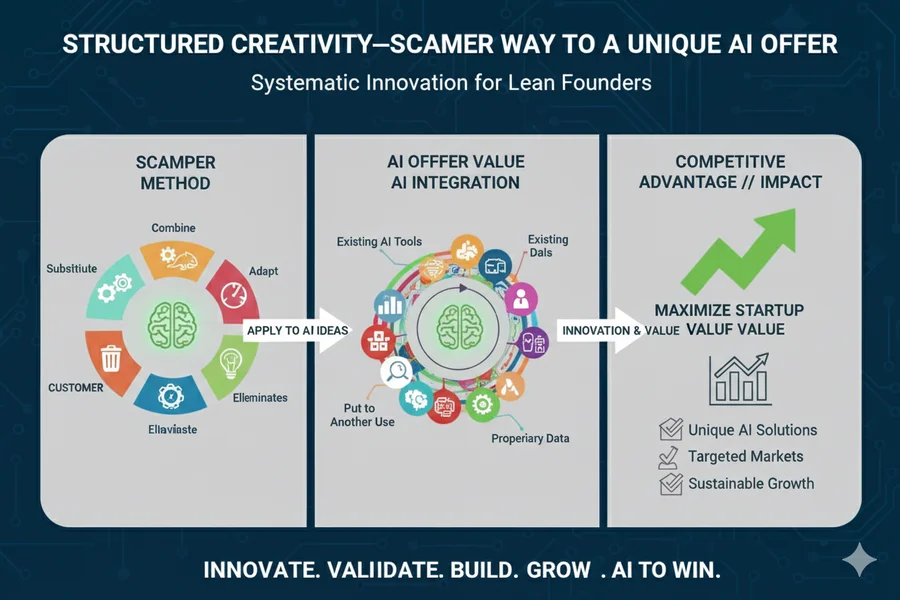
Structured Creativity: SCAMPERing to a Unique AI Service Offer
Moving past the market saturation of generic, undifferentiated "chatbox" and "AI writing assistant" ideas, the SCAMPER method provides a robust, proven framework for consistently generating genuinely distinct and defensible AI services. Popularized by creativity expert Bob Eberle, SCAMPER is an acronym that distills seven distinct, powerful creative lenses. When applied systematically to a basic, commoditized AI offering, it acts as a structured catalyst, revealing profound market opportunities that generalists and casual brainstorming sessions inevitably overlook.
The core power of SCAMPER lies in forcing a deviation from the obvious and the familiar. It transforms the abstract challenge of "How do I make a unique AI product?" into seven concrete, actionable questions.
Let's use the widely available and generic concept of "An AI Content Writing Service"—which is rapidly becoming a commodity—to demonstrate how SCAMPER dissects and reinvents a basic idea into a unique, high-value proposition.
The SCAMPER Application Matrix
The following matrix breaks down each SCAMPER lens, detailing the underlying logic for its application, a specific creative change suggested by that logic, and the resulting highly unique, often niche, AI service offer.
SCAMPER Lens | The Logic (How to Apply) | The Idea (A Specific Change to the Basic AI Offer) | The Result (A Unique, Defensible AI Service Offer) |
|---|---|---|---|
Substitute | Swap the primary interface, the underlying model, the monetization strategy, or, most critically, the target user. Change the delivery mechanism to meet the user where they already work. | Move the AI interface from a resource-intensive, dedicated web dashboard entirely into WhatsApp or Slack. Shift the user from a desk worker to an on-site field professional. | On-the-Go Social Media Manager: Designed specifically for busy, hands-on professionals (e.g., construction foremen, traveling sales directors). The user simply sends a voice note to the bot, which automatically transcribes, refines, and drafts a polished, professional LinkedIn update, complete with relevant industry hashtags and embedded photos taken in the field. This service capitalizes on convenience and location-specific value. |
Combine | Integrate the core LLM writing engine with non-LLM, real-time data elements for "contextual value." Merge the writing task with a critical business function that requires immediate reaction. | Merge LLM writing ability with access to Real-time Google Trends data and Public Company Financials (e.g., SEC Filings and Stock Price feeds). | Investor Relations Agent: An autonomous, high-stakes service that monitors a defined set of market-moving events in real-time. The instant a competitor's stock price drops, a relevant industry trend emerges, or a regulatory filing is published, the service drafts and queues a pre-approved, legally compliant reactive press release, allowing the company to respond to market shifts in seconds, not hours. |
Adapt | Modify an existing, high-value, but non-AI solution for mass-market consumption in the modern AI era. Look for solutions previously reserved for the elite or wealthy and make them scalable. | Adapt the high-end, personalized concept of a "Ghostwriter"—previously only accessible to CEOs and celebrities—for thousands of mid-level managers who need executive presence. | Executive Presence Agent: This is an always-on, deep-learning assistant. It scans a manager's calendar, internal communications (emails, Slack), and meeting transcripts to learn their authentic voice, priorities, and internal projects. It then proactively drafts personalized "Thank You" notes, follow-up emails, and thought-leadership posts based on the user's actual work week, ensuring their public presence aligns perfectly with their internal efforts. |
Modify / Minify | (Modify) Make the service much bigger or more comprehensive. (Minify) Make the service much smaller, hyper-focusing on a tiny, often-overlooked detail that creates scalable pain for large organizations. | (Minify) Don't write the whole piece (e.g., an article or product description). Focus only on the most minute, technical SEO elements: Meta-Descriptions, Schema Markup, and Alt-Text. | Micro-SEO Agent: A specialized tool designed for enterprise e-commerce stores with massive, unwieldy inventories (e.g., 50,000+ products). It solves the scalable, tedious, and often error-prone pain point of optimizing tiny, boring SEO details—details that are critical for search ranking but that generalist writers or human teams cannot efficiently handle at scale. |
Put to Another Use | Use the core intelligence (writing/generating text) for a purpose entirely outside of its obvious application (marketing/content creation). Identify industries where proprietary or legacy languages create a bottleneck. | Utilize the AI's ability to "write" and understand syntax to generate logic or code for industrial robots or legacy Programmable Logic Controller (PLC) systems. | Natural Language Interface for Industrial Automation: Instead of warehouse managers or factory supervisors needing to learn proprietary, archaic programming languages, they describe a new complex sorting or assembly routine in simple, declarative English. The AI "writes" and validates the logic into the robot’s native, proprietary language, democratizing automation and drastically cutting deployment time. |
Eliminate | Remove a key, assumed component of the standard AI experience. Challenge the fundamental input/output loop. What happens if the human is removed entirely from the workflow? | Eliminate the user "Prompt" or the need for any human input to trigger the content creation process. The AI must source its own triggers. | Headless Content Systems: The AI is given access to core business data (e.g., inventory, supply chain, customer support logs). If a specific trigger is met (e.g., a product sells out, a restock shipment is delayed, or a support ticket volume spikes), the AI automatically drafts, formats, and posts a proactive announcement (e.g., a "Restocking Soon" update to Instagram or an outage alert to Twitter) without the owner ever needing to touch a keyboard. |
Reverse / Rearrange | Flip the traditional workflow, the business model, or the relationship dynamic between the human and the AI. Instead of the human being the interviewer (the prompter), make the AI the interviewer. | Instead of the human prompting the AI with a command ("Write me an article about..."), the AI interviews the human to extract unwritten knowledge. | Legacy Capture Bot: A highly empathetic AI designed for knowledge transfer and memoir creation. Targeted at the elderly, retiring professionals, or subject-matter experts, the AI calls them once a day via a phone interface, asks a guided, sequential question about their life history or expertise, and compiles the responses into a professionally formatted, chapter-based memoir or knowledge base over the course of a year. |
Forced Relationships & Random Stimulation
The Alchemy of the Unlikely: Mastering Bi-association for Unique AI Offerings
One of the most potent secret weapons in the arsenal of innovation is the deliberate act of mental sabotage—forcing your brain to establish a relationship between two concepts that are inherently incompatible or utterly unrelated. This technique, universally known as "Bi-association," is a powerful catalyst for original thought, effectively smashing the mental ruts and industry echo chambers we unconsciously build over time. It compels you to abandon the comfort zone of incremental improvement and step into the fertile, often illogical, territory where truly disruptive ideas reside.
The core principle is simple: great ideas often emerge from the collision of disparate elements. By intentionally pairing a familiar, nagging business pain point with a random, unrelated object or concept, you bypass the analytical, self-censoring part of the brain ("That's a bad idea," or "We've tried that before") and activate the creative, associative engine ("How could this possibly work?").
The "Idea Lab" Framework: Problem Meets Palindrome
In our specialized "Idea Lab," we utilize a structured framework for Bi-association, creating two columns for mandatory pairing:
The resulting mash-ups are then explored through the lens of AI capabilities, seeking a novel application that solves the problem using the concept's core mechanic.
Deep Dive Case Studies in Bi-association
The following examples illustrate the sheer power of this combinatorial thinking:
Case Study 1: "Legal Billing" + "A Fitness Tracker"
- The Business Pain: The legal profession is plagued by the tedious, manual, and often inaccurate process of tracking billable increments. Lawyers view this administrative overhead as non-value-add "housework" that drains focus and profitability.
- The AI Concept: The "Billability Watch" (or AI Timekeeper)
- The Mechanism: Just as a Fitbit or Apple Watch tracks heart rate and steps to generate a "Fitness Score," this AI-powered application monitors a lawyer’s digital environment.
- The Execution: It runs as a background process, monitoring screen activity, active applications (e.g., Word documents, specific client emails, legal research databases), and keyboard/mouse input cadence.
- The Outcome: The AI automatically categorizes time into granular segments: "Active Legal Work" (billable) vs. "Administrative Overhead" (non-billable). It provides the lawyer with a real-time "Burn Rate" (time spent on the case against budget) and an "Efficiency Score" for their day, driving accountability and ensuring no billable moment is ever lost. It transforms time tracking from a manual chore into an automated, data-driven performance metric.
Case Study 2: "Real Estate Listing" + "The Weather Forecast"
- The Business Pain: Static property photos fail to capture the emotional or atmospheric potential of a home. A potential buyer often views a home under unappealing conditions (e.g., a cloudy day, poor internal lighting), which negatively impacts their perception, especially in digital listings.
- The AI Concept: The "Mood Filter" for Property Photos
- The Mechanism: The weather forecast is a universally understood predictor of mood and ambiance. This concept links the user's local, current atmospheric conditions to the property listing presentation.
- The Execution: The AI uses advanced generative image technology (like Midjourney or DALL-E) to dynamically alter the lighting, atmosphere, and even the "view" visible through the windows of the listing photos based on the user's local weather.
- The Outcome:
- If it's raining outside for the viewer, the AI applies a cozy, fireplace-lit, high-contrast "Night Mode" or "Rainy Day Comfort" filter to evoke a sense of shelter, warmth, and comfort.
- If it’s a sunny day, it applies a crisp, bright "Golden Hour" filter, highlighting natural light and outdoor features. This personalization creates an immediate emotional bridge, turning a static image into a dynamic, empathetic experience.
Case Study 3: "Internal Email Overload" + "A Vending Machine"
- The Business Pain: Employees spend hours sifting through internal communications (emails, Slack channels) that are often irrelevant, non-urgent, or require only a single, simple action. This leads to information fatigue and reduced productivity.
- The AI Concept: The "Communication Vending Machine"
- The Mechanism: A vending machine only dispenses a product after a specific, simple payment is made. It's transactional and efficient.
- The Execution: An AI pre-processes internal communications. Instead of sending a full email, the sender defines the "required action" (Approve, Deny, Confirm Receipt, 1-Sentence Answer). The message is delivered to the recipient's "Vending Machine" interface with the content summarized and the three key action buttons presented immediately.
- The Outcome: The recipient no longer has to read the entire thread to extract the request. They simply click the required button—their "payment"—and the transaction is complete, moving the task forward instantly. The AI handles the subsequent communication closure, significantly reducing inbox volume and decision-making friction.
The most defensible competitive moats are built precisely at this intersection of two disparate ideas.
The Moat of Defensible Innovation
By forcing these seemingly impossible relationships, you fundamentally bypass the "logical" part of your brain that seeks comfort in the known. You tap into the deep-seated associative part that dares to ask, "how could that work?" This shift is critical because it leads to ideas that are inherently non-obvious.
The most defensible competitive moats are built precisely at this intersection of two disparate ideas. When an AI solution integrates the complex problem of medical diagnostics with the simple, elegant concept of a traffic light, the resulting offering is not only unique but also exceptionally difficult for competitors to replicate. It's the alchemy of the unlikely—a creative superpower that transforms common business challenges into proprietary, defensible AI market positions.
Analogical Thinking: The "Transplant" Method
The most successful business models are rarely brand new; they are usually just transplants from one industry to another. This is Analogical Thinking. We look for a Revenue Model or a Workflow Model that is proven in one niche and "transplant" it into an AI context.
The "Subscription Box" Model → AI "Strategy Box"
Standard SaaS is a "Utility"—you pay a fee to use a tool. What if we used the "Subscription Box" model (curated value delivered on a schedule)?
- Idea: A "Monthly Marketing Experiment" AI. Every month, the AI analyzes your business data and "drops" a fully-built marketing experiment—complete with ad copy, landing pages, and target audiences—that you just have to click "Approve" on. You aren't paying for the software; you're paying for the monthly "insight."
The "Insurance" Model → AI "Compliance Guarantee"
Insurance is about risk mitigation.
- Idea: A "Compliance-as-a-Service" agent for Fintech startups. You don't pay for the software; you pay a monthly fee, and the AI continuously audits every transaction. If it misses a fraudulent transaction that leads to a fine, the company (backed by the efficiency of their AI) covers a portion of the penalty. You aren't selling a "tool"; you're selling "peace of mind."
The "Yield Management" Model → AI "Dynamic Content"
Airlines use yield management to change prices in real-time based on demand.
- Idea: An AI that changes a website's landing page copy in real-time based on the "intent" of the search query that brought the user there. If they searched for "cheap," the AI emphasizes price; if they searched for "quality," it emphasizes reviews.
The "Idea Matrix": From 100 to 1
By the end of this module in the course, our students don't have one idea; they have a Portfolio of 10+ Concepts. But a solopreneur cannot build ten businesses at once. To scale, you must be ruthless.
We use the Idea Matrix to rank these concepts based on three specific, non-negotiable criteria:
Scoring Your Matrix
Rate each idea from 1–5 on these three criteria. The idea with the highest combined score is your Launch Candidate. Everything else goes into the "Backlog" for later iteration.
Conclusion: Stop Thinking, Start Engineering
Creativity is not a mystery to be solved; it is an engineering challenge to be mastered.
If you find yourself saying "I don't have any good ideas," it just means you haven't run your domain knowledge through a framework yet. You are trying to build a house without a blueprint. The most successful AI solopreneurs of the next decade won't be the ones with the "brightest" ideas, but the ones with the most disciplined systems for generating them.
The AI Solopreneur doesn't wait for the muse. They open their "Idea Lab," they pick a framework like SCAMPER, and they work the process until a viable, defensible business model emerges from the noise.
Don't wait for the spark. Build the engine.
What’s Next?
Having 10 ideas is great, but having a profitable business is better. In Post 4: Intelligence Arbitrage, we are going to get into the "un-sexy" but vital side of AI: Economics. How do you calculate the cost of a "token"? How do you ensure your API bill doesn't grow faster than your revenue? And how do you perform a "Stress Test" on your idea to see if it will survive the economics of the real world?

No comments yet
Be the first to share your thoughts on this article!